
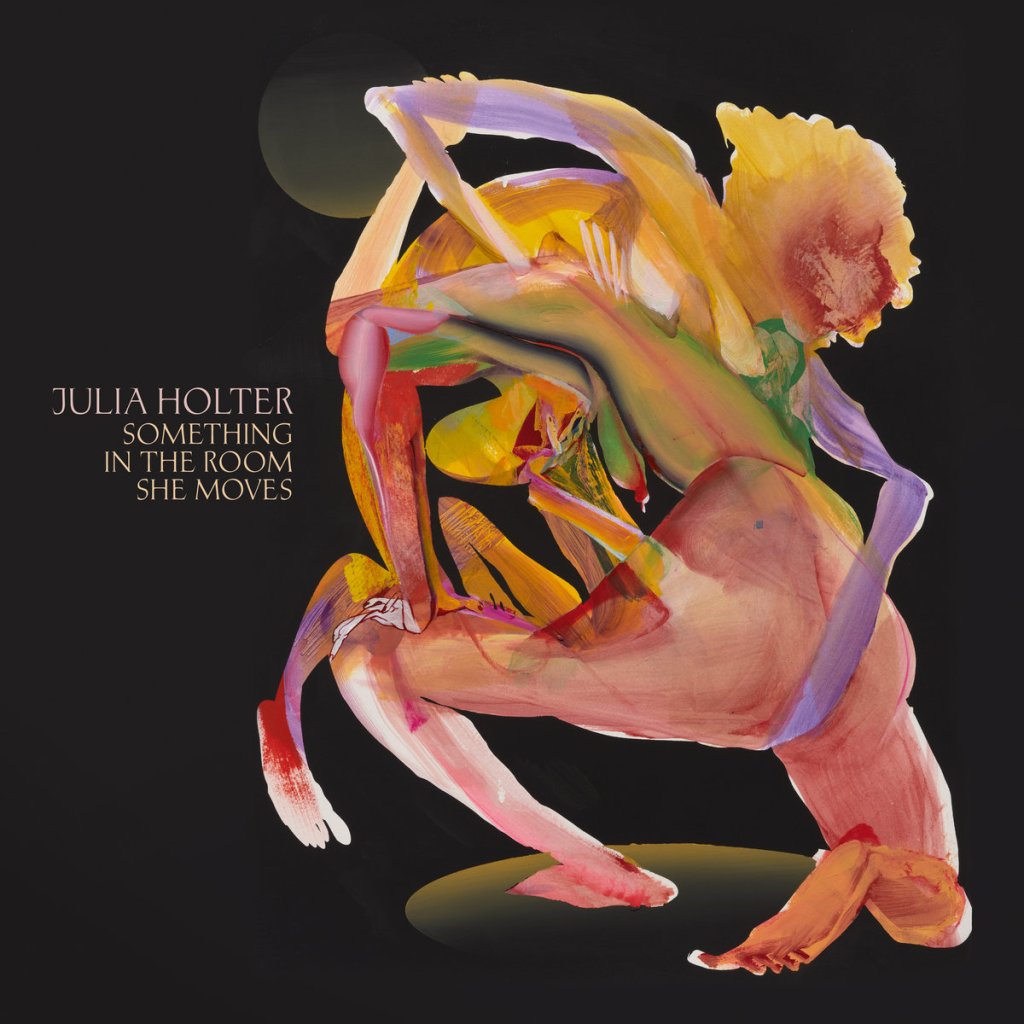
“What is the circular magic I’m visiting?” Julia Holter sings in “Spinning.” She states: “it’s about being in the passionate state of making something—being in that moment.” She definitely found passion in a collection of moments anew, singing in somatic frequencies, on her latest, Something in the Room She Moves.
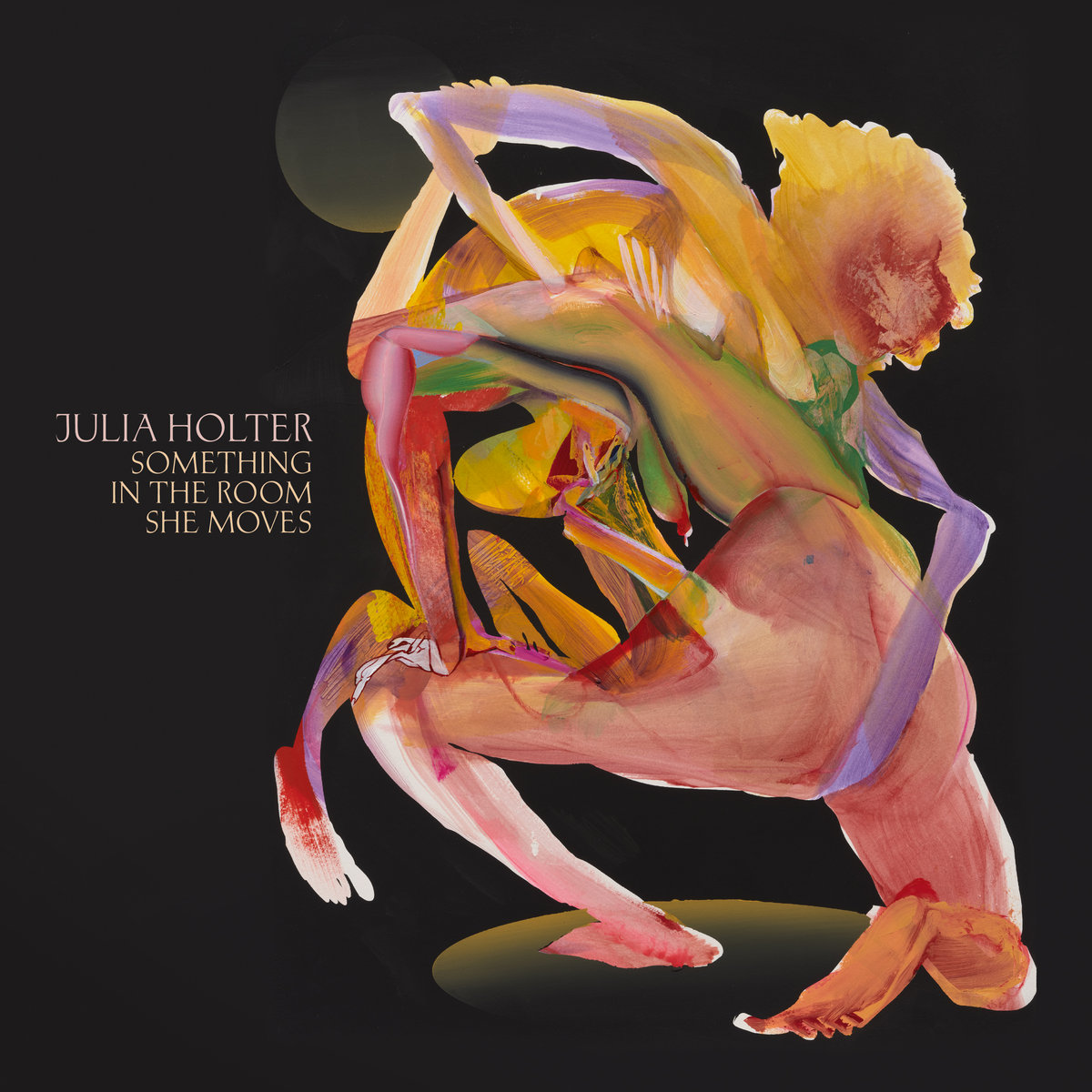
Do you ever sit in the cinema chair and find yourself watching the side edge of the projection screen where the soft light touches the total darkness, and find your mind wandering about the idea of light particles zooming through space and banging into surfaces, instead of focusing on the film itself?
This is one of the careful joys of Julia Holter’s cinematic, surrealist chamber(ish) pop music. It wanders, it holds a feeling and tickles it until it cracks, it tells you something in a whisper that you didn’t quite get, but a part of you thinks maybe you just heard the word “whisper” instead.
Speaking to this imaginary daydream of light moving through space, Holter has said of her own writing, “I like melody in a celestial way.”
I would say there are both sonic and musical implications of that statement, especially the idea of “celestial melody” itself. It implies being free from gravity, which could of course mean tonal harmony, the gravity towards a key center, and that would apply to many of her arrangements without question. Sonically, I think you could argue that the melodies of her songwriting are treated just like anything else in the arrangement as well, mixed within the harmony as opposed to separately, which is progressive considering the (albeit broken) pop form in which her songwriting operates.
But I think this concept also speaks to the idea of being more concerned with the space between points than those points themselves. The “celestial” as a place unto itself, a place to wander, as opposed to being part of a journey to or from somewhere specific.
And that’s wonderful food for thought.
Holter’s music has never shied away from letting a mood speak for itself.
Recorded music in general is about so much more than songwriting and performance — Holter is by all accounts an expert at both — but as a frontwoman her expertise in those areas has never been about the elevation of sung vocals atop a space for music beneath. This is where “arranging” and more technical processes like mixing or mastering are really in service of the same end goal, which feels more like mood than message.
What I mean to say is that, seemingly, Holter has always been more interested in floating through the space of her band than being the star they all gravitationally get drawn towards. That’s definitely on display throughout Something in the Room She Moves.
I’ve already exhausted that celestial metaphor no doubt, but let’s zoom out for just a moment longer.
A spatial pop music is a pop music that is patient, slow, lateral, meandering, planal. And the company she keeps supports this aesthetic direction for sure, enlisting other vocalists like Jessika Kenney, Ramona Gonzalez, and Mia Doi Todd, as well as seasoned fellow composers and experimenters Tashi Wada (her partner, and whose father Yoshi pioneered a few new formations of cloud-adjacent durational musics himself), Sarah Belle Reid, and Chris Speed, among others.
On pieces like “Ocean,” and “Meyou” (below), songform pretty much gives way entirely to spatial, melodic play.
Based in Los Angeles, Holter is a capital “W” Working artist. Recording, composing, touring, sitting in, scoring, she’s always Working and it shows. (Why her gorgeous score for the 2020 film Never Rarely Sometimes Always isn’t as widely known or highly regarded as her other records is both a mystery and a crime.) There are some artists who work so infrequently that you can tell they’re packing as many ideas and intents into their songs as they can. Yet Holter’s voice and vision on the other hand span across an enormous body of work, via her own creative output and contributions to the records of others.
It’s not hard to find excuses to constantly compare Holter’s work to cinematic art, but this really reminds me of Wim Wenders’ The Road Trilogy (1974-76), which are three isolated stories that all draw from the same narrative tool box.
And I keep going back to this idea of “spatial pop” because it’s obviously inherent in the music itself on Something in the Room She Moves, but I really find that there’s a long-playing through-line across all of her work that connects an infinitude of points just below the surface. Albums and scores may tell individual stories, or be anchored by specific concepts and catalysts, but Holter’s message is designed to unfurl over time.
In another very kind metaphor, you could think of it like the musical equivalent of Agnes Martin’s life-spanning oeuvre.
How does it feel to sit in a Holter record? (Asked nobody, but I’m answering anyway…)
To me it feels like we’re caught between a wandering dream and a buoyed idea. The idea rocks up and down at the surface of a body of water with meditative repetition, it moves in the wind and the tide, we sink and rise with it, we see the horizon in 360 degrees of clarity but it’s always changing. It never stops roving, and it’s not going to give you answers or sell you a packet of steaks, it’s not something to hedge your bets on, and it doesn’t come with a calendar invite. It’s everything laid out in front of you, but disappearing as you try to read it like sand through your fingers at the end of a dream.
I’ll have another go at that.
Holter is a fly-fisher, casting out a wobbly reel, of which her song is tied to the end. The song is never cut loose entirely, but its master is both the fisher and the river, and it gets handed off between them in a fluid spectrum of agency. The trust that we won’t be cast off into the wild entirely is something neither party is willing to cultivate, that’s on us to discover. It’s exciting and weird and addictive, it’s a rush, and pleasurable, and licorice.
Holter’s work first arrived at my ears with Ekstasis, which at the time (2012) was unlike anything I’d heard. It was vocal driven but more Meredith Monk than Bjork per se. It recalled for me Annette Peacock in that it felt deconstructed yet hyper melodic and anchored in form at the same time. Even though at the time I remember being blown away by other off-kilter vocalists like Maria Minerva, Holly Herndon, and Juliana Barwick, Holter’s sound found a lane with no other traffic at all somehow.
Another cinematic connection, the first song on that record is a reference to Alain Resnais’ 1961 film Last Year at Marienbad. And that made so much sense to me, because in a way, this record was just as steeped in dreamlike surrealism and memory logged imagery as its namesake. Since Ekstasis, Holter’s artistically brilliant crew has expanded, her records have become more high-fidelity and richly instrumenalized, and her fandom has grown immensely, yet this surrealistic dream motion, the buoy rocking up and down, has remained the best lens through which to regard her songwork.
It’s never going to be entirely clear, there will always be a bit of condensation on the glass. Sometimes, even, the condensation is the point.
Listen and purchase here, please.
 The Royal Editoryal