
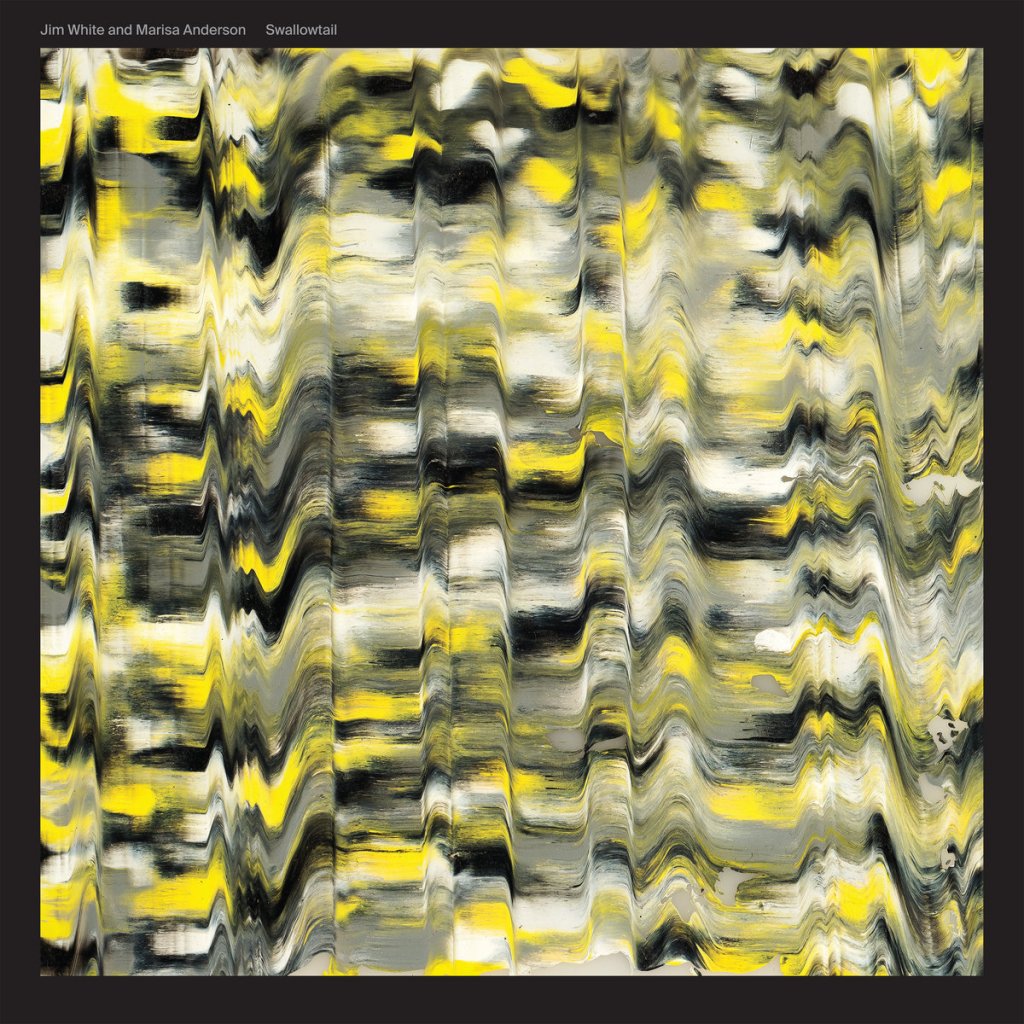
The collaboration between renowned drummer Jim White and acclaimed guitarist Marisa Anderson is a natural union of two of the most intuitive players and listeners working in music. 2024’s Swallowtail is a deepening of the trust they forged on their first record together, 2020’s The Quickening, with White and Anderson completely immersed in the moment, each attuned to the other fluidly moving as wind and water.
A swallowtail is a butterfly.
In fact, it’s over 550 different species of butterfly, native to every continent on the planet (except for Antarctica, big surprise). They’re known for their bright, distinguishing color patterns and for their forked hindwings, borrowed from the likeness of a swallow’s tail, which bifurcates beautifully for balance and agility through the air.
But the butterfly has other stories to tell. The swallowtail has been known to culturally represent the graceful, free-flying fortitude of the human spirit. In literature and poetry it will stand in as a symbol for hope, endurance, change and transformation. Its colored wings are used as a defensive weapon of distraction and intimidation to other cohabiters of the animal kingdom.
You can see where I’m going with this.
If you’ve never heard Marisa Anderson, Jim White, or their collaborative music, we can start right here at the metaphor of the butterfly. If you’re as familiar with the entirety of these artists’ musical output as I am over the span of 20 something years, well, that metaphor should already fit as snug as a caterpillar in a chrysalis.
- Freeform, evolutionary music that reinforces the human soul at its core? Check.
- Using beauty and bright colors as a shield against the ills of the world? Check.
- The shape of a bifurcated tail, stemming from a singular point and expanding in two independent creative directions? Check.
Imagining the inspiration of the butterfly on this music also gives me an enormous appreciation for the abstract cover artwork, which may just be derived from an image of the furry flying creature.
Marisa Anderson, an improvising folk revivalist guitarist hailing from the Pacific Northwest, and Jim White, an Australian jazz drummer who founded the influential trio Dirty Three among many other projects, forged their creative iron in quite different furnaces. But their ability to come together in moments of sparked creative elevation is so synced it may as well be magnetic.
Here, and almost always when together, the two players eschew recognizable melodic motifs yet play with repetitions and patterns as a singular yet independent body of water might. There are reflections and permutations, a stretching and an invisible current pulling, but never totally distorted beyond comprehension. Like river waves refracting the perspective of a submersed branch, we’re never quite out of the realm of certitude about what we’re looking at, but the picture never stops its cycle of reformation either.
Thus, their music is an exercise in steady change, employing slowly-felt redistributions of energy in pockets to perpetuate the greater flow as glacially as that may pass.
Take a listen:
As the swallowtail flies, an aerial dance of whipped oxygen unfurls from its batting foils. The spectacle is mesmerizing, what is the butterfly’s true intention flapping around as if tumbling like that? To “wing it” is to improvise, to play it by ear, to take wing, to fly by the seat of one’s pants. Why do we always associate freedom with flight?
121 years after the so-called “birth of flight,” we still can’t reconcile with the lack of an organizational hegemony imparted by the experience of solid ground supporting our stance. Moving in all directions at once, no dependence or allegiance to any systems but gravity, being swept up and away by the unseen hands of the wind…
Why does this scare us?
Why do we dream of the limitless plane of the sky above only to recoil at the fantasy of making a home in the clouds as many artists so willingly do?
It must be related more to the fear of falling than the pleasure of ascending. Musicians with folk traditions coursing through their veins aren’t always likely bedfellows of total non-structure, but these two seem to have no fear of falling whatsoever. Leaving improvisation aside for a moment, music in general is often a prompt for us to lean more into floating, movement, and living for the evolution of life; as opposed to its stasis.
Drums aren’t supposed to tell you which notes to hear or feel more deeply. That’s not exactly the responsibility of the kit. Here, they do by default. Listen to the way he accentuates non-accented beats in the measure, almost as gestural prompts to just keep listening. White feels those beats, Anderson’s stringed stabs, those microscopic moments where blood flow through the veins gets a little warmer. Little wrist flicks or ankle jabs at the kick will transform into tiny traffic lights letting some notes go and others halt, en route through our cerebral cortex.
This is White’s superpower and as subtle as it is to hear, you can’t help but feel it too. The three-track “Bitterroot Valley Suite” is filled with these propulsions. Anderson and White see the forest for the trees in every rhythmic bar, but delight in showing you the marks on the trees themselves as they pass them by in stride.
The alignable ear.
Theirs is an intuitive musical connection, but it isn’t entirely foreign from the sound that the magnificent Dirty Three concocted. Guitarist Mick Turner was the thunder rumbling inside the physical, electric lightning created by Warren Ellis’s violins and White’s drums, yet for all that pent up and explosive energy the trio could wield, so many of their most memorable land strikes were of a softer kind. The pretty, chordal shapes this trio fashioned both in improvisation and composition would go on to influence so many wide-eyed post-rockers, or refocus their lenses, because what really happened in that music was the idea of living in the sky. They rode the wind, they dove to hunt and rose to escape, and gave all of us a bird’s eye view to grapple with when each record was over. I still hear the notes of Ocean Songs and She Has No Strings Apollo ringing between the leaves of surrounding trees on a windy day. I could talk for days about Dirty Three but thankfully I am able to exercise some self-control for our purposes here.
Marisa Anderson doesn’t need to worry about the great shadow cast by Dirty Three though. Her shadow is large enough, and her sound true enough, to hold its own. Anderson has channeled the ghosts of Elizabeth Cotten and Robert Johnson in her amplified Americana, and resurrected countless authorless hymnals to open ears, for years. She captivates with honesty, the unabashed unhidden strokes of a guitar used like a paintbrush, the recollections of struggle and landscape.
Anderson’s sound is steam-powered riverboat that bends with the banks of a Mississippi-style river and churns up sand from the shallow bed beneath. A folk music with no words, her fingers tell the campfire stories they recount on their own and in abstracted form.
Music can be so many things. Here I believe, it’s an invitation to build a home in the sky.
Please check out Jim White & Marisa Anderson’s incredible release, courtesy of Thrill Jockey Records, via the link below.
Listen and purchase here, please.
 The Royal Editoryal