

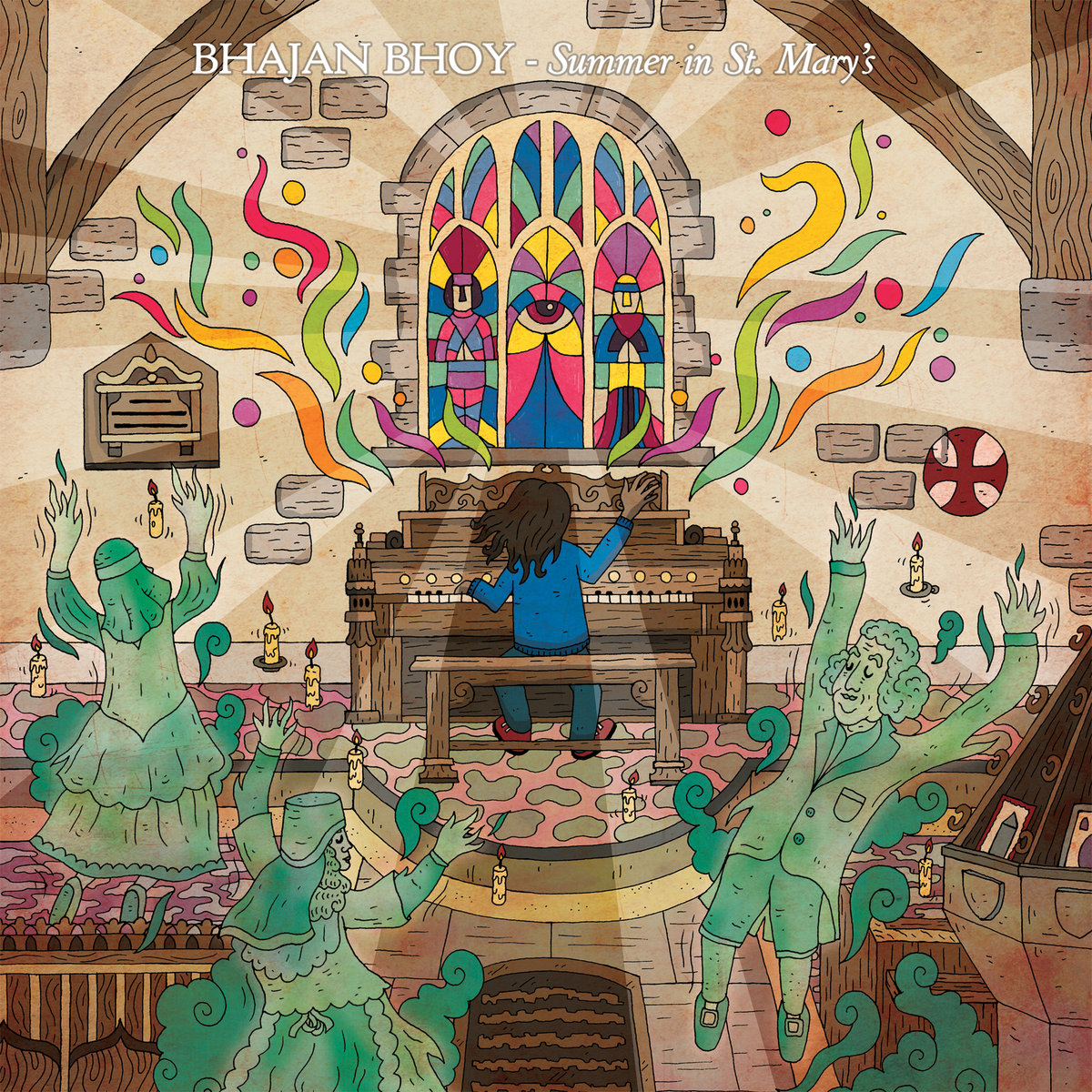
Ajay Saggar, aka Bhajan Boy’s Summer In St. Mary’s is an album of beautiful, minimalist compositions with repetitive motifs, played on a 19th century organ in the 15th century St. Mary’s Church in the village of South Cowton in North Yorkshire. This album is released in partnership by Feeding Tube Records (USA), We Here & Now (Canada), and Wormer Bros. Records (NL).
Among the greatest challenges there are in music, the ability to either make the complex sound simple, or to make the simple sound interesting, remains a watermark of true mastery.
Ajay Saggar’s work touches this talent like the tips of a tinted paint brush touches the fibres of a canvas. With delicacy, subtlety, and a heaping dose of he absolutely couldn’t care less.
At least that’s the impression I’m left with as this work, which I consider to be that of a master, is accompanied by such a casual air, it’s as if the artist is almost begging us not to take it too seriously.
This album is a collection of eight durational works, recorded in a 555-year old church on a 125-year old organ by a solo performer. In Saggar’s case, the repeated intervalic phrases that make up this suite are indeed simple—at least simply constructed—but his employment of minute variations in tempo, articulation, attack, performative gestures, and rhythm, are what give these simple compositions enough fuel to light a very interesting flame.
It takes no longer than a few seconds to get the gist of the sound world that Saggar has created here, and that’s only because he made the correct choice not to elaborate on the sound world he initially set foot into when he entered the St. Mary’s Church in North Yorkshire. Another reason why this all feels so, frustratingly, and yet brilliantly, laid-back.
And like any immaculate first impression, while its effect may linger, that is only a part of the experience of getting to know a new friend. This music certainly grows only more intriguing and fulfilling the more time you spend sitting and listening to it. Music like this indeed asks more questions than it wishes to answer, which, for a record made in near-total solitude by a single artist, is definitively un-selfish.
A man alone at the organ, with a penchant for long, cyclical dervishes. It’s not really about the artist at all it seems. It’s about a moment, and the space that moment takes to dissipate.
Take a first listen:
Listening to organ music, one must always be reminded that the instrument is an entire work of carpentry, furniture and architecture, and a living, breathing mechanism. Its bellows inhale and exhale the very air that its player breathes, in lockstep. The sound of the instrument, especially one this old (built in 1896!), hand-crafted for both function and ornamentation, may never simply be reduced to its keyboard tones.
An organ is a body, and an organ’s sound is its entire body.
Its creaks, its shutters, its rattles, wallops, and hisses.
The organ’s amplifier is the room it lives in, a room usually constructed in such a way as to maximize its resonant properties, and in most cases, the only room that particular organ has ever known. Its sound changing with fluctuating temperatures and humidities, an organ may sometimes get a sore throat, and it may sometimes get congested.
If it sounds like I’m trying to draw a palpable comparison with the intimate experience of us humans in our own bodies, well brother, that’s exactly what I’m trying to do.
Thus, Summer in St. Mary’s is meditation music. But not exactly in the form we’ve come to expect from late 20th century new age and minimalism—although this record is surely repetitive, thematically oriented, and built of long form durational pieces. Of course it draws from those creative touch points. But it’s meditation music in that it is an exercise in oneness between the artist and his tool, a body interacting with another body in space and time, a kinship of energies, wherein the result is transcendence.
It doesn’t get more meditative than that. To listen to this record, as a spectator and outsider, is to give up one’s intellectual positioning, weighed by judgment, and instead submit to the feeling of being in an extended, joyful, honest hug between Saggar and his instrument. To sit in this moment, to let it sing to you, and to let it pass over you.
Like a cloud, a harem of wild horses, a distant satellite, or a summer’s day in North Yorkshire. These are things which simply “are.” When they come into view, or we come in contact with these things, we are left contemplating their “is-ness.”
I find that Saggar’s work on this record puts forth less of a composer’s statement, and more of a Zen outlook, on a music that feels as much a transference of action from performer to instrument as it is from instrument to performer. Is-ness.
Make no mistake about it, this record is loooooonnngggg (like this review!), especially by today’s standards. You could fit like three Earl Sweatshirt albums into these 83 minutes.
I often think about duration or length in fixed media artwork in relation to cinema. Long films aren’t always better than short films, and certainly not because they’re long; although runtime does tend to cast a pretty big shadow in the dominion of critical reception. But my saying is that I apply to most things is that “a work’s creative entropy should beget its length.”
In other words, does the rate of a work’s ultimate decline justify the time it takes to arrive there?
It has, surprisingly little, to do with an audience’s attention span most times, in my opinion. And almost nothing to do with what people say is happening to our attention spans as a species… (That’s a topic for another day.)
I think Pierre Étaix and Norman McLaren’s short films are better than Bertolucci’s Novocento or Sinclair’s Shaka Zulu. Some of the best punk albums are jam-packed with 1-minute bangers, some of Mahler’s symphonies are too fucking long. And yet, if you’ve ever heard Satie’s Vexations performed, or Éliane Radigue’s Occam Ocean or a performance by Sarah Davachi, all typically featuring minimal variations of simple intervals or melodic fragments over enormous, monolithic durations, or seen a screening of Christian Marclay’s The Clock, these are experiences that can tell you a whole lot about yourself.
All things end. Some things attempt to stave off their own ending for as long as possible, but in reality sometimes a more condensed experience is a better one.
And so, the eight 10-minute long pieces that make up Summer in St. Mary’s are unfortunately burdened with having to justify their lengths. These are, once again, very minimal musical works. Thankfully, I think they do just that. A piece like “Gauntlet” for example, a rumbling tumbling single chord “drone” huffing and puffing air through harmonic tubes with periodic stabs on the 5th, is so compelling throughout its entire duration, that it could and should in fact, be twice as long.
Because this is not a “drone” record, or even an ambient record. It just isn’t conceived, constructed, or recorded to be a background soundscape. It’s a heavy, cyclical, prodding pursuit, rough around the edges and not without blemishes; it’s courageous and restrained in the same dusty breath.
This is a music that sets up the questions, leaving room for you to pursue the answers, if any exist at all.
Please check out Bhajan Boy’s work and purchase Summer In St. Mary’s via Feeding Tube Records (USA), We Here & Now (Canada), or Wormer Bros. Records (NL) depending on your location.
Listen and purchase here, please.
 The Royal Editoryal