
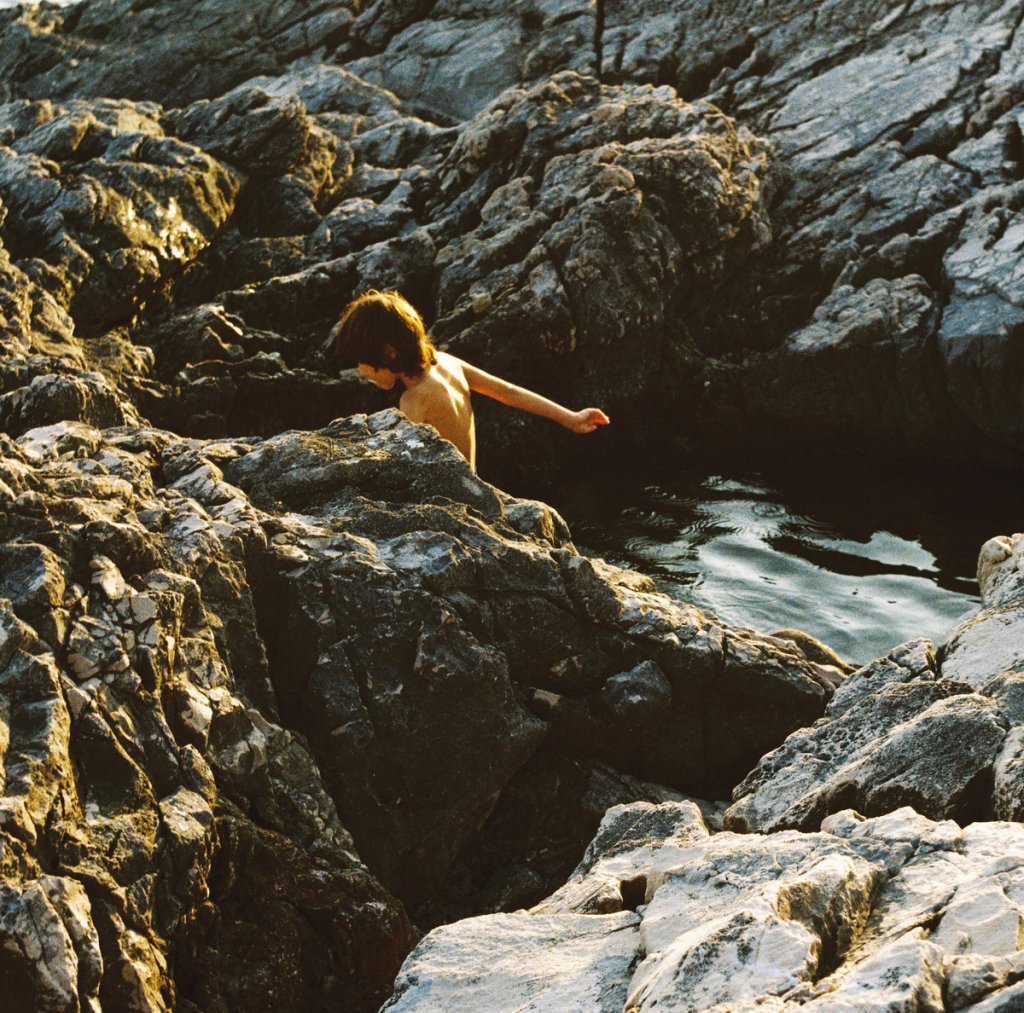
Rekem Records presents the new album by artist and researcher, Manja Ristić, Sargassum aeterna, a programmatic four-track suite framed by a fantastical narrative set in a dystopian future—the year 2221—where today’s social and ecological contradictions have reached their most extreme conclusions.

Sound artist and classically trained violinist Manja Ristić’s new album-length work, Sargassum aeterna, is an ambient album wrapped in an imagined dystopian narrative depicting Earth’s eventual ecological catastrophe at the hands of human power struggles and industrial over-exploitation on a global level.
More specifically, the (fictional) story goes like this:
It’s the year 2221, society’s actions and inactions have contributed to a future world in which catastrophes such as disturbances in the Earth’s magnetic field, a global war (North vs. South), destructive ocean mining, and the suspension of human rights, have made this planet virtually uninhabitable save for a select few, fighting over scraps.
There are barely any traces of animal life left at all, although in some faraway places, survival has shown to be possible.
The music and sound design of the record reflects the anxiety and melancholy, as well as a complicated beauty manifested in the desolate silence and vastness of a post-apocalyptic world. A stillness, the kind of idle quietude that may accompany a thinking machine as it’s sleeping, or an dried out salt marsh, hovers over everything.
Drones, hydrophones, contact mics, field recordings, the faint sound of a young voice in dialogue with an unknown past and a bleak future. The story is both the soundscape and soundtracked by it. Like how the sea is both the gentle calm it inspires in us, and the rough, chaotic tumult it uses to teach us about the powers we’ll never have.
Does that also describe…. God? Oh brother…
I am not ready to go there.
This is obviously a conceptual album, but this storyline is mostly peripheral to the listening experience. It’s not mandatory that a listener keep this in mind, yet the music is so open-ended that having an imaginary narrative landscape to dip into is an incredibly enriching affair.
And one I’d highly recommend! Let’s take a first listen:
Musically, this is a courageously minimal album.
If you enjoy a music of lightness and artfully precise placements of sonic texture, this should be in the stack on your night table to get to at some point. Fluid synthesized tones and chords, echoing and wafting in glacial paced stillness, are conjoined with spacial white noise, water rippling and cascading, and the chirps, chatters, and rustling of a vibrant Earth in its present tense, recorded above and below the water’s depths.
Everything is in flux, yet bound to a reflexive gravity shared amongst all things.
We understand this in totality to be music, but how much of it actually is?
I’m not trying to knock Ristić off any kind of creative pedestal here, instead this is somewhat of a thought exercise. Siting outside the grounds of a factory you’re likely to hear the humming of some massive motor or the whirring of an industrial air conditioner, not unlike the faraway tonal current of “Sacred Land”—which builds and approaches like a sandstorm from the horizon to our person in onrushing cloud. Likewise, the dual-tone melodies that kickstart “Halcyon’s Nest” could easily be mistaken for ship horns on a foggy shore.
Because the pieces on this record are filled with so much naturally derived sound in addition to tonal material that carries an air of (wo)man-made-ness, it could almost be slotted in as a stand-in for our physical presence in the wild world, in the now, in the very age we’re living in. No holds barred.
All together, our ears perceive this sonic and musical accumulation as raw data when it enters our field of audition. How that data is read and interpreted is informed by everything we know about an artist’s work, what’s been said about their work in media, what we’ve just read in an album’s liner notes, and, of course, the leaps and bounds of our fertile imaginations.
I’m trying to get at what’s really happening when we take a plunge into a conceptual work, and especially one as minimal as Ristić’s. Our wandering minds use the ear’s sonic data package to build a picture in a visual way, it bounces around the halls of our memory library to find references that help make it familiar, we attach one or two symbiotic storylines culled from our own experience on Planet Earth, and… voilà, clicks and clacks become the chattering of a microbial species struggling to survive in a bleak desert wasteland, and the whooshes and whistles of static become the post-apocalyptic winds of a post-human desolation.
We hear it twice. Once in the ear and next in the mind.
And yeah, this resulting piece of work has some seriously dark corridors to emote.
It’s ominous.
It hums and haws and hisses and scratches.
The more Ristić leaves out, the more our brains fill in the gaps left behind. Ristić writes the prompt, but we write the story. I kind of adore how bleak this story truly sounds, how Ristić sculpted it to sound. One can’t help but hear this as a cautionary cry for healing humanity’s relationship with our environmental home.
There’s another element to this record that grips me.
I am not a gamer, but this piece has the feeling of being perfectly suitable as sound design to a sci-fi video game. With just enough emptiness and just too little information to be pinpointed to a scene in particular, it can fit a variety of idle landscapes, awaiting pursuit.
An ambiance of stillness, grafted to an imaginary topography.
In one listen, I felt that I’d been let out of a 1994 Cadillac Fleetwood on the side of the highway by an unfaced driver, to meander the desert darkness on my own with nothing but a flashlight.
In another, I was standing on an edge of a cliff so high that beneath my toes dangling off the rock’s drop I saw a lightning storm brewing in fury inside billowing nimbostratus.
In another, I felt that I was swimming up towards the shimmering surface of a lake, murky around me but crystal clear in the approachable above. Turning my head I could watch my feet slowly pedal and produce tiny bubbles vectoring away from my digital body. Turning my head yet again, a waving branch of kelp beckons my direction next.
In all of this, I hear a “teachable suspension.” Not always literally constructed from suspended chords on a theoretical level, it’s more in the idea of leaving the listener with a suspended amount of tonal information. Neither fully dark or light, and modal enough to pursue melodic or textural through-lines in any direction. Teachable, a vessel for communication without saying much at all.
What is the artist’s role? It isn’t always to “tell” a story, but perhaps simply to allow space for stories to blossom in a landscape brushed into existence by the artist’s stroke.
It’s not often that being suspended is in itself, a wholistic experience. “Suspense” is almost always used to augment the telling of a story. Yet I think in a small way, this is the point of this work. While perhaps not venturing so far as to attribute a fully fleshed out statement regarding the end of our world by humanity’s inept hand, this future-glancing auditory orb accepts its own hypothetical construction and suspends the protagonist from carrying out any concrete action.
An anti-narrative?
One way or the other, something about the landscape of Sargassum aeterna rubs me in an eerily uncertain way, and this fictional realm of dark nature is not a place I want to inhabit anytime soon. (In the best possible way.)
Please check out Manja Ristić’s work and purchase Sargassum aeterna via Rekem Records (based in Athens, Greece).
Listen and purchase here, please.
 The Royal Editoryal