
The 2025 edition of Suoni Per Il Popolo, Montréal’s annual festival of free, improvised, and experimental musics across genre forms, took place throughout the month of June. The Royal Editoryal was invited to attend the festival and share my impressions.
Montréal in the summer is a see-saw of weather patterns.
A squall, a storm, a sirocco, a canicule.
Like the two weeks of pendulum temperatures and ping pong barometric dive bombs we experience here in June before real summer takes over and after our sorry excuse for a spring finally decides to die another snail’s death, the sounds of ecstatic and creative musical expression bounce back and forth across the Rue St-Laurent between Suoni Per Il Popolo’s three main venue spaces, La Sala Rossa, Casa Del Popolo, and La Sotteranea, for two unforgiving, unforgettable weeks.
Wooden chapels of sweat that creak, rumble, and flicker.
It’s hard to overstate the importance of this festival here, even in a city graced with the likes of MUTEK, Akousma, Jazz Fest, Nuits d’Afrique, Les Francofolies, and Osheaga (actually I take that last one back). Open eyes enter and open ears exit with ink-dipped wrists, night after night. Night after night, artists perform, artists drink, audiences mouths get stapled to the floor, audiences drink, then across the street, 24 hours later the artists become the audience and the cycle continues.
Creativity is the hydrologic circulation that evaporates one night and precipitates locally throughout the scene, throughout the year. The programming of this festival reflects how Montréal has become both a meeting place for Canadian and international artists to gather and collaborate as well as its own engine for homegrown artistic expression.
Here are some of this year’s dirtiest moments.
Naomi McCarroll-Butler & Jason Doell’s duo performance of shifting feedback, pickups, drones and resonances, was a carpet of needles somehow both sharp and soft. A comforting experience, a support system of empathetic openness and listening, wrapped in the piercing, chilling fabric that feedback and frequency weaves through a room. Their work offers anyone an opportunity to lay down on spikes without the danger of being run through.
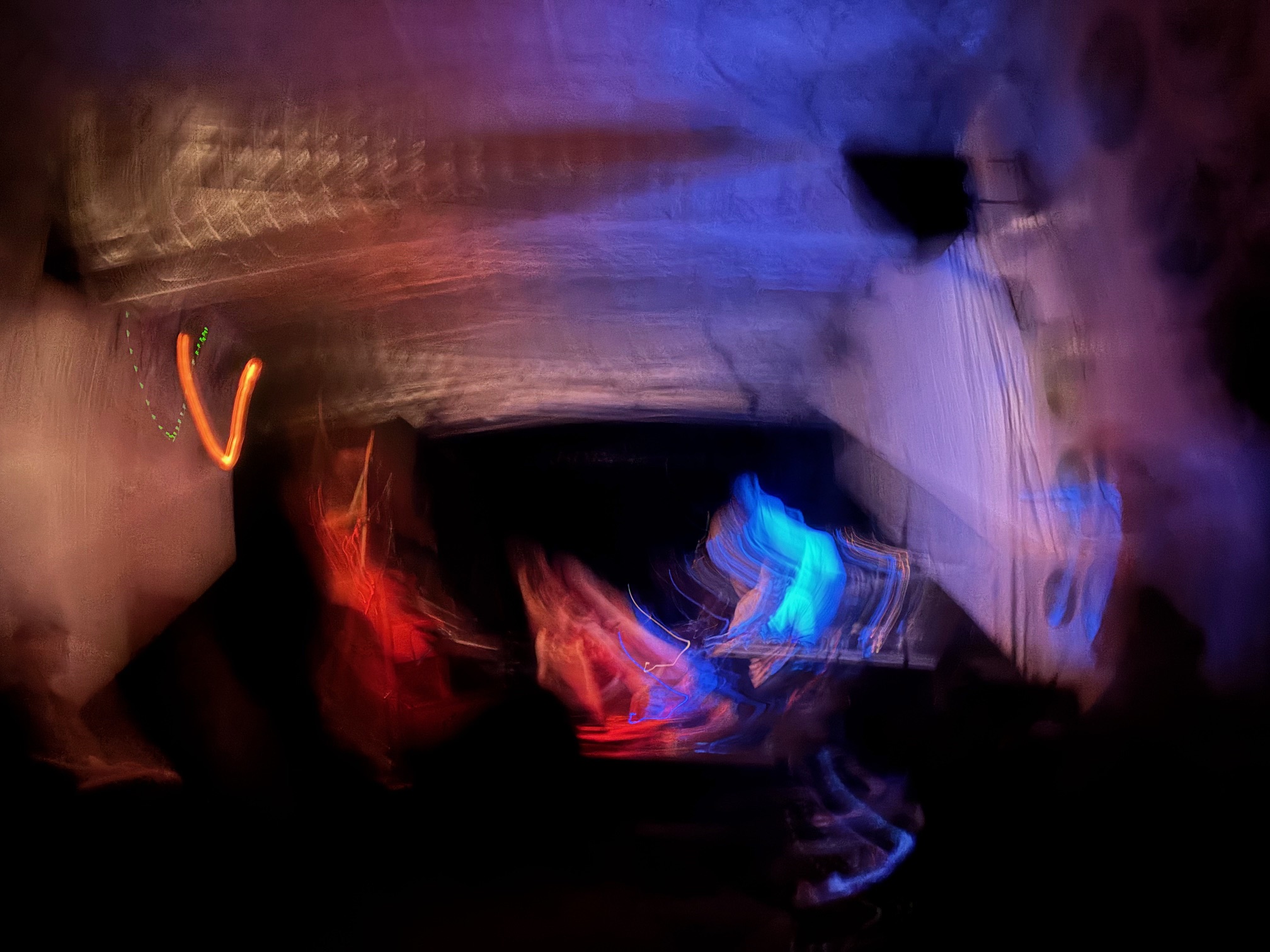
The solo performance (and group “orgy” as she calls it) of Farida Amadou was as “embodied” an examination of electric bass technique I’ve ever seen. Literally using her arms and chest as a percussive resonator with her hand on the bass guitar’s pickup, she pounded note attacks on her body like an irregular heart beat in stretched time and rhythms that felt like chewing gum.
Where so much openly improvised music relies on moving away from establishments of rhythm, Farida’s overexertion of it turned the room into a giant bucket where each hit became an accumulating droplet of water leading to pure submersion. Farida’s music is a dish best served splattered across the floor.
The digital tapestries woven by Stefan Christoff and Daniela Solís combined ambient soft synths, field recordings in nature, and documented audio from protests and political actions in solidarity with human rights and anti-colonialism, and live spoken word poetry. What felt at first like a relaxing, mauve-hued sound bath eventually grew cacophonous like a Towel of Babel, voices like bricks being stacked into a fortress of multilingual collective strength.
The discord of droning consonance being met with an emotive multiplicity of voices rallying for change, was a clash that felt elevated in the way that the experience of community, as fierce as its potential, can be just as much a home to intimacy as association.
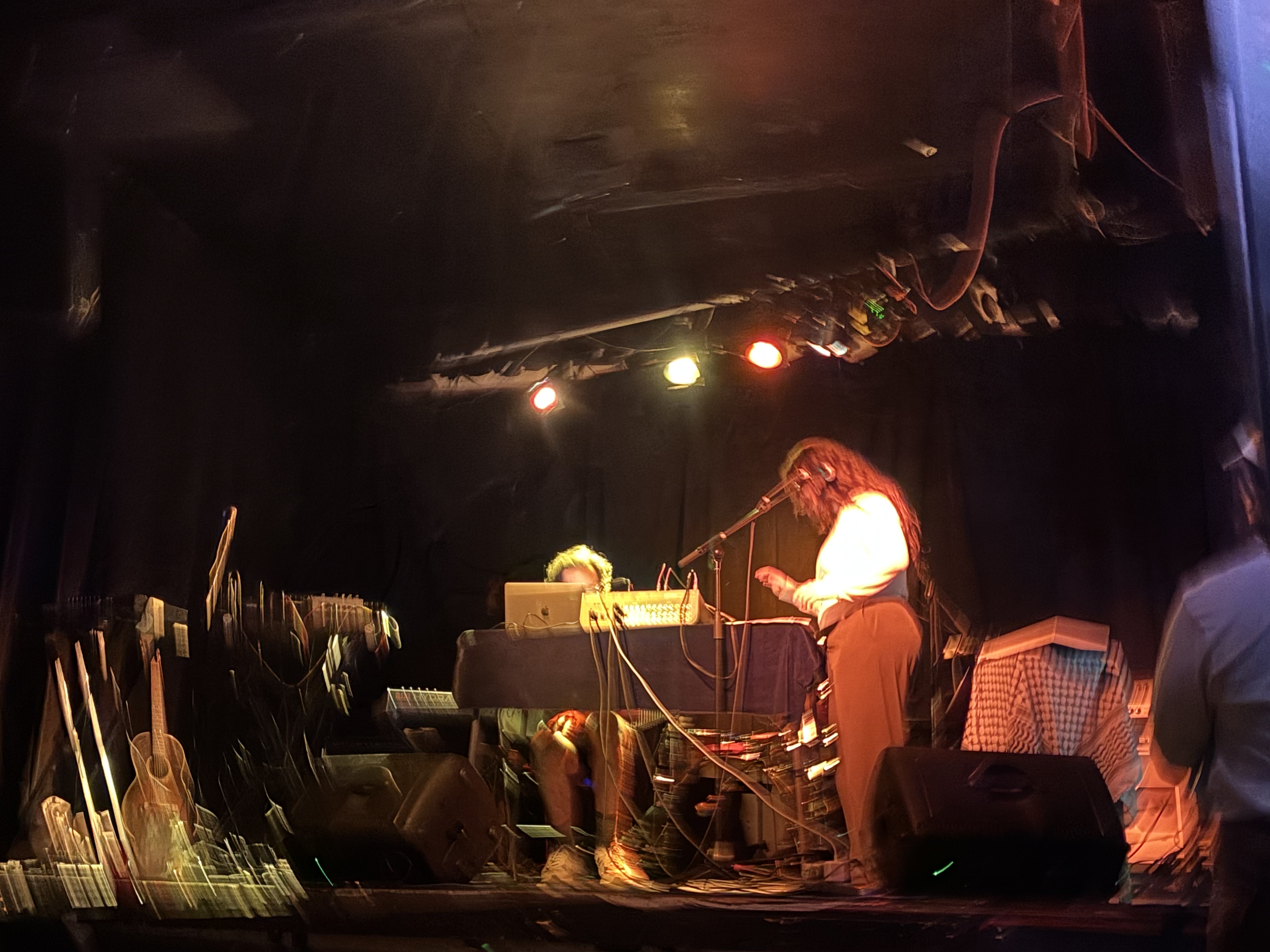
Can pastels ever be anything but banal and inoffensive? This was the question I couldn’t wrap my head around during Jairus Sharif & Mustafa Rafiq’s encapsulating duo set of saxophone, electronics, and semi hollowbody guitar. Wait, what? Why? Well, here’s why.
The music these two seasoned improvisers make when they share the stage has a glowing light to it. An orange, yellow, sun-drenched kind of ray field that bathes the room, like an intense morning light reflecting down onto and off the concrete in a strip mall parking lot. And yet, there’s a darkness to it. A real-ness, a rough, crumbly edge that reminds you you’re in a fucking strip mall at dawn, what the fuck is wrong with your life, man?
Hence, can pastels ever be this harsh? Will we allow it? What if the entire crayon box has been lying to us all along? There’s something to be said about a music that changes everything we’ve come to absorb with regards to how colour communicates a feeling. I choose a punkier shade of canary (and I think the boys would too).
Lebanese invitées SANAM, a supergroup sextet of masterful performers from Beirut brought a floral ferocity that bloomed and wilted in front of our eyes like a botanical experiment in timelapse. Their sound had an ephemerality to it, big rock energy, very much in the present, but with lilting descending vocal melodic lines that hinted at the fragility of all things, the fractured, fragile state of our current moment. SANAM to me is a dark room with a rose-colored flicker dancing across the wall that catches your attention and grips it when you’re trying to fall asleep. They’re a stampeding herd of legless bucks on a plain, a floating mass of force that makes no sound at all. They’re a long string that never knots and never tangles.
A leopard in a hare’s clothing, Nennen brought a fierce tenderness in paired-down duo form (with Robyn Gray) to the stage. Songs driven by brittle grace and deep fried in emotion, her voice-leading technique is like an inky calligraphy brush that hits the page with pawing vicissitudes of pressure and lift, moving across the page beckoning the double guitars to follow in harmony. Dissonant drones met microtonal, melodic singing to coalesce into a rich, glistening heat.
Sometimes experimental, improvised music is like opening a book to a random page and starting to read from there onward. The page’s choice. In this experience, you come in knowing nothing but know that you’re entering a story world that is bigger than this here glimpse. You know there’s a protagonist in there somewhere, but you can’t hedge your bets just yet on who that might be, so you pay attention to everything, you follow threads. This unknown path you tread with blinded eyes is something impossible to grasp, fully, but the forward progress of the narrative is compelling, immediate, and thought-provoking.
Like SlowPitchSound’s performance. The fluidity of it all is hidden from the ear until the very end. It doesn’t matter where you enter, he’s been telling this story on his own terms and without your attention or approval, all over the country for years. A turntablist with a deft touch, Cheldon Paterson builds abstract stories using samples and deconstructed bits of sound programmed into rhythms so fluidly deployed, they feel like extensions of his own limbs.
In fact, Cheldon is like a cobbler. He sits in his workshop of leather sonic goods—he really only needs like 3 or 4 tools to basically piece together any size or shape of shoe—and he’s been perfecting his craft for so many years he could do it with his eyes closed. If you’ve ever seen SlowPitchSound perform, you can picture it just like I do: a man in the daylight of a workshop window, surrounded by scraps, creating and amending gorgeous works while a little bell rings to signal a customer’s come in.
And then there’s Engone Endong, the sonic surgeon. Mostly making use of samples, triggered and treated with a DJ’s hands yet composed and employed by the hands of a musical performer and composer, his hip-hop organized rhythmic approach brings West African instrumentals and natural found sounds together in a wholly unique playpen of joy. Engone is a tactile mathematician, where SlowPitchSound (above) is like an old-fashioned artisan and craftsman of tactile sensitivity and feel, the latter operates with pin-point, premeditated precision that would stand up to any beat-making laboratory scrutiny.
A wonderful moment for the people of Montréal was to witness the new, explosive, full-band sound of prolific producer, rapper, and musician Quinton Barnes up close and personal. Quinton’s normally a pretty smooth cat; the Black Noise Ensemble was a messy, frizzy, uncouth, 18-car pileup of a hip-hop band gone rogue into places dreamt up by Alice Coltrane, Sun Ra, The Last Poets, Death Grips, and Anohni & The Johnsons. And Quinton, never afraid to explore honesty and personal trauma in an almost religious devotion to his storytelling practice, filled whatever gaps left by the bigness of this positively charged ion of sound energy, with emotive singing, speaking, and sass. Donned in leather jacket and silk durag, the writer wrote off the heatwave and refrigerated a packed joint with abstract song novels of and in living drama.
Fusion is a tricky word. On one hand I guess everything I enjoy is some kind of fusion, because straightforward anything is cliché and uninventive at this point in our modern history, but on the other it can be a complicated endeavour to quilt together a sound or a style based on picking and choosing some (and not all) elements of a cultural product. It has to come from within. When everything’s a recipe, we sometimes forget that its our own hand doing the chopping and sautéing.
Mestizx, a group led by singer Ibelisse Guardia Ferragutti from Bolivia and American/Puerto Rican jazz drummer Frank Rosaly (now both based in Amsterdam, and both composers), performs a high-octane psychedelic samba that’s as North Illinois as it is South American. They’d hate me for saying that but the jazz school triads say different. It’s an imaginary beast that’s three parts peacock, two parts elephant, and one part tortoise (get it?). Their controlled ecstasy fuses these animal instincts together into an elemental rhythmic sphere.
And isn’t that always the case? Rhythm is so often the great deliverer of cultural entanglement, a stowaway too often brought along for the ride of colonialism and enslavement. Rhythms and dances remind people of what they had to leave behind, and over time their inherent gravity starts to pick up particles from the new place and swirl them around to create something never before heard out of the newer, adopted struggle. Rhythm can thus always be an oasis of joy, an agora of resistance, and a playground of catharsis, in spite of all the struggle that surrounds it. So when Mestizx’s set catapulted great barrages of rhythm, internal combustion motors of syncopation, into the sound system, it was a palpable reminder that no matter how dark it is out there, you can always retreat into the darkness of an underground dance club to feel the positive flow of fusion in your body.
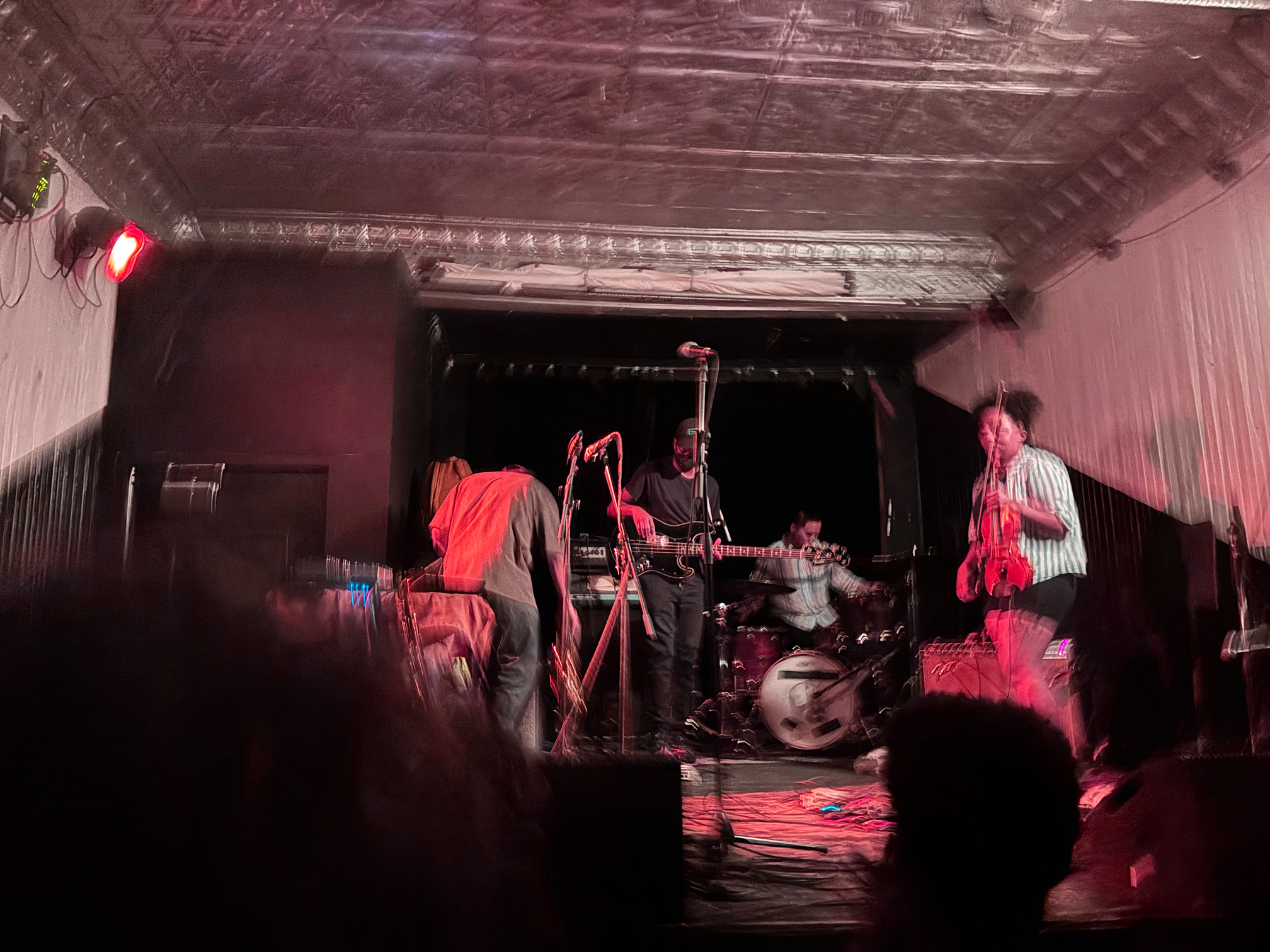
A cinematic, improvising quartet, The Egyptian Cotton Arkestra, pursued pastures of minimalist fog en route to free jazz-derived sonics. All active musicians lending their talent and tenacity to a myriad of projects around town, James Goddard (sax), Lucas Huang (drums), Markus Lake (bass), and Ari Swan (violin), create something together that’s more akin to a living, growing, cranky organism than a definitive stylistic bullseye.
In fact, Egyptian Cotton sounds like if an alien spaceship landed in a soybean field in Kansas, the aliens exited the hatch and took a look around and decided the “got” Earth. That they understood Earth to be basically flat, a pretty empty and desolate place with maybe 100 lifeforms, and that it wasn’t totally unlike some parts of their planet (or planets they’ve visited before). But then they get back in their spaceship, and take flight up to where the winds are more active and the lights buzz on and off, gliding over the sprawling Chicagoland area, and they realize holy fuck bucket, this place isn’t what we thought it was at all!?! what in Zorb’s holy name is going on here? This planet is chaotic, frenetic, dense, violent, productive, and playful. This planet is the movement of peoples. And this music is the soundtrack.
Radwan Ghazi Moumneh’s stark solo presence on the purple and red lit stage put forth immersive, electronically drenched voice and buzuk, with processing that tore through the speakers like curtains of splinters or a pile of glass shards swept together like Robert Smithson’s “Map of Broken Glass (Atlantis).” His one man image in suit and under spotlight almost looked like some kind of AI-spun Leonard Cohen but with a pickled voice, signal buried alive under terra strata of static and washed away by a tsunami tide of husky low-end bass waves. The floor shook. Heads fell.
The ravine-shaped performance of Steve Bates & Elizabeth Anka Vajagic took what one might consider to be the corporeal makeup of a song and ossified it in roving improvisation before bringing back a fossilized version of songform in a coda. Digging up through a perplexing sedimentary basin of both raw and electronically treated guitar drone and contact mic noise, Elizabeth’s darkly guttural preaching by poetry is something that may have referential influences but will never be duplicated. And Steve’s mining of the guitar for string and body sound forms reciprocally feels like it rents space from Lee Ranaldo, Sven-Åke Johansson, and Dean Roberts, yet is designed and furnished totally of his own searching ear.
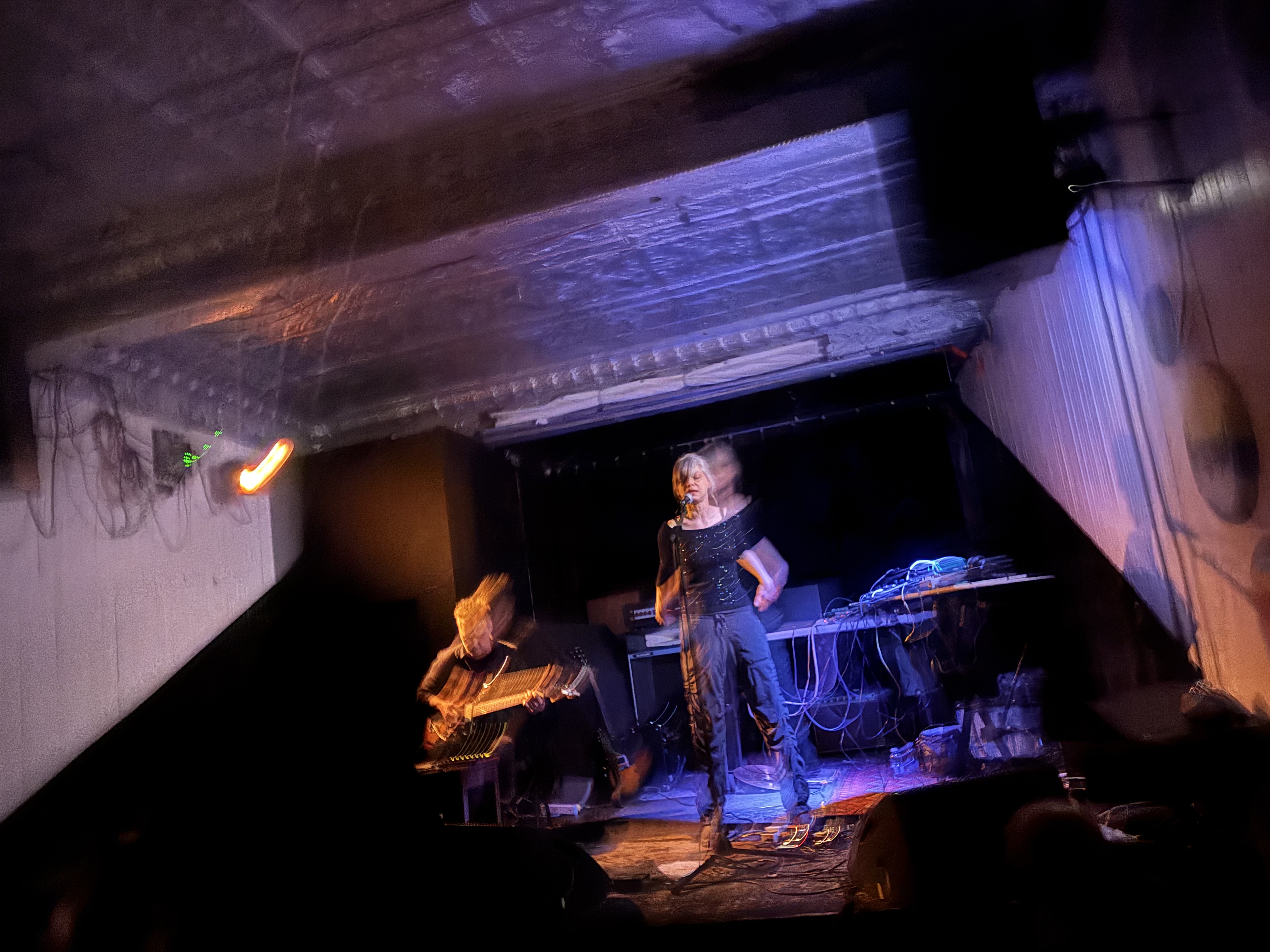
The coils of copper wire that Hiro Kone turns into music feel, in fact, just like that: metallic meshes fraying with split-end filaments. The patterns pierce, the architecture of the sound is hidden behind a box of notched-up modules, but how every synthetic chord and sound design character play in a space is very much a palpable, felt experience. To be caught like bycatch in this web of electricity is a pleasant kinda pain, ya dig?
The noise duo of Ky Brooks & Mat Ball took a similar liberty with pain with similar results. A full-blown feedback and distortion dronescape accompanied by periodic text-tangential screaming and sledgehammer whacks at a (poor, helpless) standing cymbal, people licked it up off the floor; it was that good. Their slow-burn corrosion unfolded like a long, slow panning shot up a 60-storey limestone quarry on 16 millimetres of celluloid.
Most festivals set up high stages in summer evenings designed for their audiences to gaze up at the skies and the stars. There is no depth of connection, no intimate dark magic, only the spectre of longing for a time when our shared skies were not filled with the fireworks of falling missiles, the noise of sirens and the drones, the smog of smokestacks, and the panopticon data omnipresence of satellites.
Suoni is a celebration of dirt. It sounds like dirt, tastes like dirt, and it’s as powerfully connective as it is because it comes from the dirt beneath all our feet. Local up-and-coming artists walk this dirt and international visiting artists gallop across it on horseback, and the recognition that the pavement spackled over that dirt is also spackled over generations of conquest and eons of exploitation, is the point. In this ecstatic groundedness, there isn’t the luxury of looking away, or looking up to the clouds.
We must look down. Down is where the things are that have been buried, hidden from us, and where fresh and organic seeded things are always beginning to grow anew.
Look at the pavement to find joy, and not to the sky for false hopes.
*A very special shoutout goes to all the bartenders, sound and lighting tech, the door volunteers, show runners, and drivers, and everyone else behind the scenes that worked all throughout the festival!
Learn more here about the Suoni Per Il Popolo Festival, and read about all of this year’s participating artists here.
 The Royal Editoryal